- May 30, 2025
How are you going to get there?
- Sherry Wright
- 0 comments

You've decided you want to play better golf. You have collected your statistics and know where you are losing strokes and what parts of your game you need to work on. You've used that information to set your goals. Now what?
You need a specific and purposeful plan that will actually produce results for you so you can meet your goals.
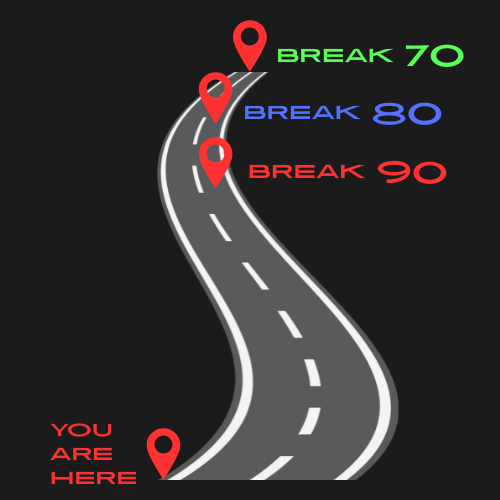
You need a ROADMAP to guide you.
I thought I was working on the right things until I played in my first USGA event. Looking back, this experience is really what kickstarted my journey with creating my own roadmap for game improvement. At the time, I didn't realize this was starting to cook on the back burner. Each tournament I played in, provided more proof of what I needed to focus on and what was important.
The process of preparing for a big tournament and self reflecting afterwards is where the magic happens for my game. I get better with some aspect of my game whether technical or mental when I sign up to play in a tournament. The pressure to get ready to the best of my ability before a tournament is where I really narrow my focus with the timeline leading up to it. Regardless of my actual performance in a tournament, I always make progress and improve something within my game just from preparing for and playing in it.
I'll never forget the feeling of standing on the first tee box and having my name announced at my first USGA Mid-Am. I distinctly remember looking out at the really thick rough lining the narrow winding fairway thinking, "Boy, I better know what I need to do to get the ball in the fairway". I had so many different swing thoughts, so much anxiety and uncertainty about the outcome of my shots, my score, etc. The nerves were on high red alert. What stress! I didn't play golf as a kid or even in college to have the years of experience learning how to play in tournament, to have the confidence, and specifically how to manage my emotions and adrenaline. This was trial by fire. I had zero mental game preparation, all of my focus was on my swing mechanics. I relied on my athleticism and natural competitive instincts to guide me. I ultimately performed very well to my standards for my first USGA event, making it to the Round of 32 on my first try.
During this tournament, I was all by myself. I didn't have a caddie. I replayed the mantra in my head, "get behind it, stay behind it, stay in my posture". I repeated this for the entire round and survived my first national championship. After I got home, I returned to practicing with even more purpose now that I had this experience under my belt. I learned that by the time you get to one of these tournaments, you better not still be searching for things in your swing or your mental game. This all needs to be sorted out well in advance in all of your preparation leading up to it.
When I came back from this tournament, I continued to work on my swing (a never ending process!). I also had a pressing desire to learn more about managing my thoughts while out on the course. I knew I needed to be better with my course management strategies and figure out how to be more committed with each shot. I needed to understand me better. I needed to figure out what makes me play my best golf.
Playing better golf really involves so many different aspects of your game. This is why your plan for game improvement needs to be organized, logical, pinpoint focused on each element that goes into your game. You need to be working on so many different things to put together a well rounded game that can provide you with some consistency and lower scores. You can bet your opponents are checking off all the right boxes for the work they are putting into each part of their game. This is where a well thought out master plan for game improvement comes into play.
I gathered up all of the things that I had gravitated towards in my pursuit of game improvement when putting together the Break 70 Roadmap. When you look at all of the components that go into your swing mechanics, course management strategies, mental game approach and practice routines, it can really be quite overwhelming. This same feeling was all too familiar to me. In my Physical Therapy Doctorate program, there was so much information we had to learn daily for 3 straight years that it felt completely impossible. So overwhelming in fact, you felt defeated before you even got started. I know a lot of people feel this way when they decide to seriously work on their game and then realize the extent and depth of what is involved.
In order to survive grad school, I learned how to chunk information into smaller more manageable parts. I focused on that one small piece, then onto the next small chunk of information. I followed that same blueprint for game improvement. I organized each specific focus area into what I call Breakouts. Each of these Breakouts allow you to get good at each individual part of your game. It is the sum of all of these parts that will form your overall game. In Physical Therapy, this is the treatment plan.
I really enjoy the process of working on getting better. Being able to take the time to focus on what I'm trying to accomplish. It's not the result that is the prize. It's is the process of it all. The process we go through is what makes the end result. We get better over time, if we are working on the right things. Our game improvement requires some marinating time. Put good thoughtful quality ingredients into it and let it marinate. Let all the different flavors get a chance to work together to eventually produce a wonderful dish or in this case, your game! Much like the downswing, you can't rush it.
You can spend hours upon hours practicing and playing, but if you aren't working on the right things, then you are not moving the needle in the right direction.
So what ingredients are you putting into your game?
What is your treatment plan for game improvement?
This is incredibly important to get right.
If you would like a comprehensive plan to help improve your game and achieve your goals, check out the Break 70 Roadmap.